
Off-the-Shelf Insoles vs Custom Orthotics: Which Option Is Best for Your Feet?
Many people assume custom orthotics are automatically the best treatment option. In certain circumstances this is true, and a bespoke device remains the gold standard when significant correction is required. But depending on the condition and the wider treatment plan, spending £400–£500 on custom orthoses isn’t always necessary. At Podplus we stock a range of off-the-shelf orthotics that can achieve comparable outcomes for many presentations, at a fraction of the cost.
When Off-the-Shelf Devices Do the Job
There are several common conditions we wouldn’t typically treat with custom orthoses as a first-line intervention, including plantar fasciitis and Achilles tendinopathy. In these cases, a large degree of structural correction usually isn’t the priority, so a well-chosen prefabricated device combined with the right rehab programme is often sufficient.
When Custom Is the Right Call
For conditions such as PTTD (adult-acquired flatfoot), we’d typically still recommend a custom device given the level of correction required to control subtalar joint position and offload the posterior tibial tendon. That said, we now carry a Bio Post Tib range that includes a medial skive (which helps align the subtalar joint) along with additional modifications such as wedging and heel raises. For the right patient, this can be a suitable stepped-down alternative to a fully bespoke device.
Decision Criteria: What Actually Guides the Choice
| Factor | Favours off-the-shelf | Favours custom |
|---|---|---|
| Condition | Plantar fasciitis, Achilles tendinopathy, general arch/pronation support | PTTD, cavovarus foot, complex deformity, diabetic foot at risk |
| Degree of correction needed | Mild-moderate | Significant structural control required |
| Foot flexibility | Flexible, reducible deformity | Rigid deformity needing precise contouring |
| Activity level/demand | Recreational, general daily use | High-load, sport-specific, occupational demand |
| Budget/timeframe | Lower cost, quicker turnaround | Higher upfront cost, longer lead time |
| Previous response to treatment | First-line trial, new presentation | Failed prefabricated trial, recurrent symptoms |
Cost-Benefit Framing
| Device | Price | Notes |
|---|---|---|
| Hapla base w/ modifications | £30 | Entry-level, simple accommodative modifications |
| Vionic | £55 | Off-the-shelf arch support, general use |
| Interpod | £75 | Semi-rigid, more structured correction |
| Bio Post Tib | £85 | Our go-to for early-stage PTTD requiring rearfoot control |
| Custom orthotic | £495 | Gold standard, individually cast, the shell lasts up to 5 years |
Off-the-shelf devices can also serve as a trial-and-error period, letting us test which modifications a patient responds to before committing to a custom device. If you’re confident you want to go straight to custom, the manufacturer we work with offers a 10-week fit and comfort period, during which we can make modifications at no extra charge.
Materials and Modifications: Not Just a Generic Insole
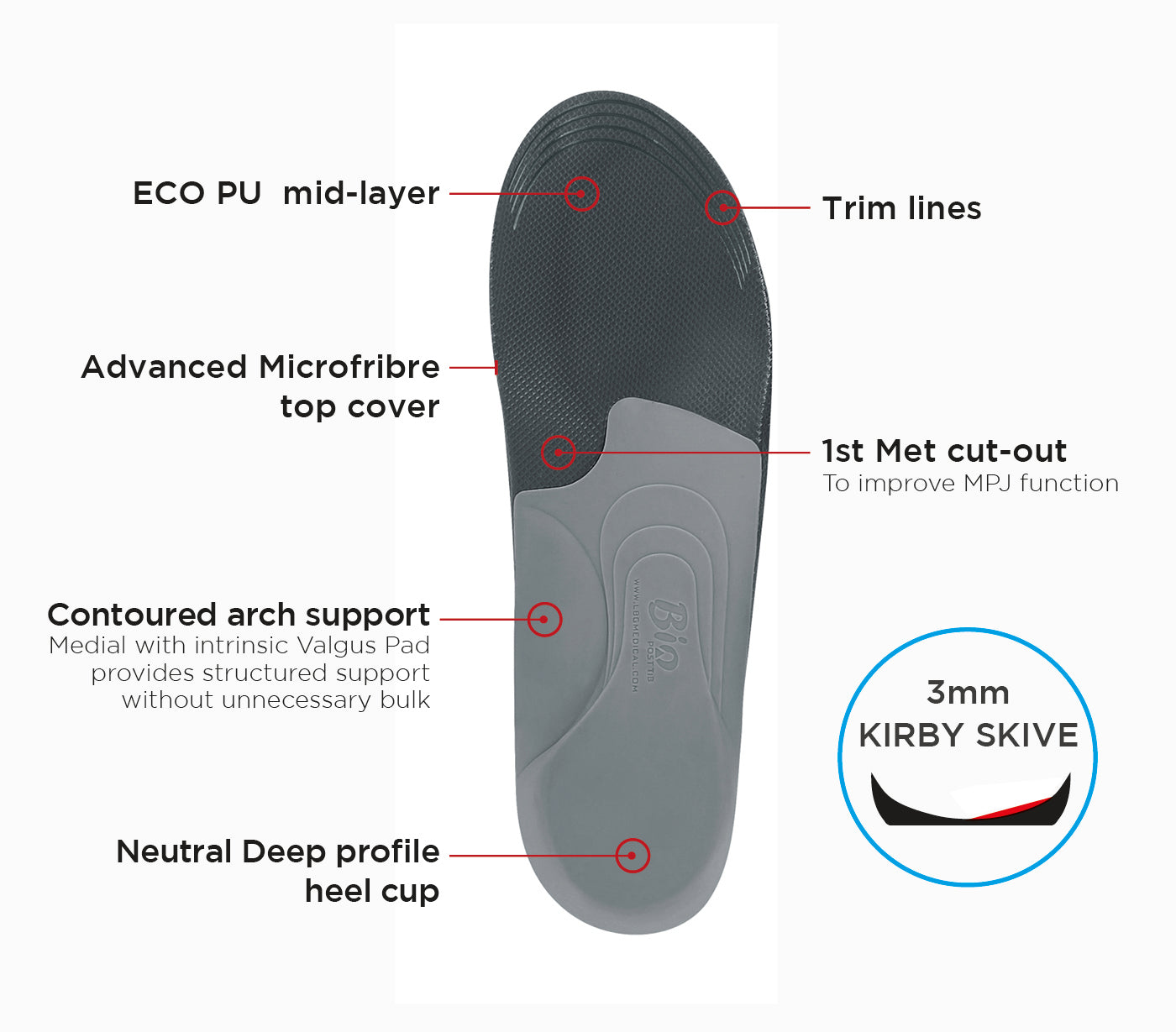
Despite being off-the-shelf, devices like the Bio Post Tib are built with specific materials and features designed to influence foot function, not just cushion it:
- TPU shell — provides the rigidity needed to resist deformation under load and maintain control through stance phase.
- Arch support with valgus pad — adds comfort while helping support the medial longitudinal arch.
- 1st MTPJ cut-out — improves function at the big toe joint during propulsion.
- Deep, neutral heel cup — increases rearfoot control and calcaneal positioning.
These features are what allow a prefabricated device to approximate the biomechanical control of a custom shell for the right presentation.
What the Evidence Says
For plantar fasciitis, the literature consistently shows prefabricated and custom devices perform similarly. A review of clinical and cost-effectiveness evidence found no difference between custom-made and prefabricated foot orthoses for pain reduction or functional improvement across short-term, medium-term, and long-term follow-up in adults with plantar heel pain.¹ A randomised trial comparing low-cost EVA devices reached the same conclusion, reporting similar effectiveness between prefabricated and customised foot orthoses in the treatment of noncomplicated plantar fasciitis after 8 weeks of use.² As one commentary summarised, the literature supports prefabricated orthoses as being just as beneficial as custom devices in the treatment of plantar heel pain, so the clinical question is less about custom versus prefabricated and more about which design controls the relevant kinematics.³
For Achilles tendinopathy, the comparative evidence is thinner. Custom-moulded foot orthoses have shown efficacy in randomised controlled trials for chronic Achilles tendinopathy, alongside heel lifts, night splints, and shoe modifications.⁴ Biomechanical work comparing a customised arch support against a simple heel lift found foot orthoses with medial arch support work by correcting biomechanical malalignment and reducing tendon load, with success rates reported as high as 75% in runners from case series and retrospective surveys, though the same authors note there’s still limited head-to-head evidence establishing which orthotic design is superior.⁵ In practice, this supports our approach of starting with a well-modified off-the-shelf device for milder or newer presentations, reserving custom devices for patients who don’t respond or who need more precise rearfoot control.
It is important to note that evidence in Podiatry is constantly developing and in some areas has been under-research, custom orthotics have begun to be paired with objective data collection such as static and dynamic pressures which identify peak pressures, which is particularly useful in creating a preventative insole vs treating the cause of a problem when it becomes a problem.
When to Escalate to Custom
An off-the-shelf trial isn’t the end point for every patient. We’d typically move to a custom device if:
- Symptoms haven’t meaningfully improved after 6–8 weeks of appropriate off-the-shelf use and rehab
- There’s progression of a structural deformity (e.g., worsening PTTD staging)
- The foot is rigid and needs precise, individualised contouring that prefabricated shells can’t achieve
- Modifications to the off-the-shelf device have been maximised without adequate symptom control
- The patient’s activity or occupational demands require a level of control beyond what a semi-rigid device can offer
Book an Assessment
The right starting point depends on your specific presentation, not on price alone. If you’re dealing with heel pain, Achilles symptoms, or a flatfoot deformity, book an assessment with the team at Podplus and we’ll talk you through which option — off-the-shelf, Bio Post Tib, or fully custom — fits your feet.
References
- Canadian Agency for Drugs and Technologies in Health (CADTH). Custom-Made Foot Orthoses versus Prefabricated Foot Orthoses: A Review of Clinical Effectiveness and Cost-Effectiveness. Ottawa: CADTH; 2019.
- Wrobel JS, Fleischer AE, Crews RT, Jarrett B, Najafi B. A randomized controlled trial of custom foot orthoses for the treatment of plantar heel pain. Journal of the American Podiatric Medical Association. 2015;105(4):281–294.
- Hawke F, Burns J, Radford JA, du Toit V. Custom-made foot orthoses for the treatment of foot pain. Cochrane Database of Systematic Reviews. 2008;(3):CD006801.
- Munteanu SE, Scott LA, Bonanno DR, et al. Effectiveness of customised foot orthoses for Achilles tendinopathy: a randomised controlled trial. British Journal of Sports Medicine. 2015;49(15):989–994.
- Farris DJ, Kelly LA, Cresswell AG, Lichtwark GA. The functional importance of human foot muscles for bipedal locomotion. Proceedings of the National Academy of Sciences. 2019;116(5):1645–1650. (Provides biomechanical rationale supporting orthotic interventions.)